The debate over power tariffs has quickly been reduced to a question of sauna use and electric car charging. This is misleading—and risks leading people astray.
Peak-load rates are not being introduced to punish households that happen to use a lot of electricity at the same time. They are being introduced because the Swedish electricity system faces enormous investment needs. And the real reason is something entirely different from sauna heaters.
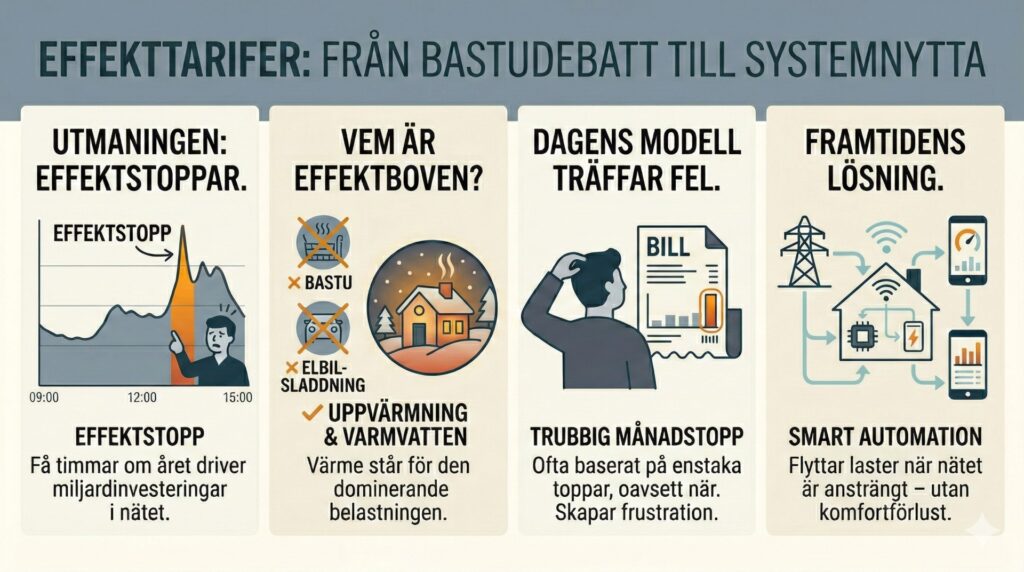
The problem is the power spikes—not electricity consumption itself
It is not the total amount of electricity we use that drives the costs in the power grid. It is the few hours each year when the load is at its absolute peak.
When many households heat their homes at the same time on a cold winter morning, the grid must be designed to handle that specific peak load—even if it occurs only for short periods. It is these peaks that necessitate investments worth billions in cables, transformers, and grid reinforcements.
If we don't manage the peak loads, electricity grid charges will continue to rise. The alternative to peak-load rates is not the status quo—it is higher costs.
But today's models are off the mark
At the same time, the criticism of how power tariffs are currently structured is, in many cases, justified.
Basing the fee on a household’s highest measured peak power consumption during a month—regardless of when it occurs—is a crude measure. A single peak can result in a high fee even if the grid is otherwise under light load at that moment.
This creates frustration and uncertainty. Consumers don't know what the cost will be until they receive the bill. And the connection between behavior and the actual benefits of the system becomes unclear.
It's not the concept of power tariffs that's the problem. It's the way they're structured.
The Real Culprit: Global Warming
To put it plainly, it’s not the sauna or the electric car that’s driving the power peaks. It’s heating.
During the winter months, heating and hot water account for the majority of power consumption in electrically heated single-family homes. When temperatures drop sharply, the load increases dramatically—across large geographic areas at the same time.
This is where the systemic issue lies. Everything else is a peripheral phenomenon.
Making electric vehicle charging the main issue is to confuse symbolic politics with energy system analysis.
Without automation, it won't work
We cannot build a future electricity system based on households poring over hourly schedules and manually managing their consumption.
Power tariffs require smart, automated control. It must be possible to shift larger loads away from the hours when the grid is under the heaviest load—without compromising comfort and without requiring people to take active action every day.
The technology exists. What is needed is for the rate models to work in tandem with it.
Do it again—do it right
If we want power tariffs to work, three things need to happen:
- The fee must be based on actual grid load during the hours when capacity is strained—not on random monthly peaks.
- Consumers must be provided with transparency and predictability in real time.
- The focus must be on the major loads—especially heating—where the real system benefits lie.
On Gotland, models are currently being tested in which the rate is based on actual grid load and combined with the electricity price in the same signal. This allows households to know the real-time cost of electricity, while heating can be controlled automatically without compromising comfort.
That is the kind of modernization that is needed.
Power tariffs are not a threat to households. They are a necessary tool for avoiding even higher grid fees in the future. But they must be intelligent, targeted, and technology-neutral.
The debate needs to be elevated from the "sauna level" to the "system level."
Björn Berg
Head of Strategy and Development
Ngenic Energi