Ngenic Energi has been optimizing heating in Swedish homes for over 15 years. Through continuous development and smart control, Ngenic Tune helps reduce energy consumption without compromising on comfort.
Now, a new study based on data from just over 1,000 households shows that the greatest energy savings do not always occur when it is coldest outside. On the contrary, the greatest relative savings often occur in the spring and fall—when the sun warms the house during the day while the nights are still cold.
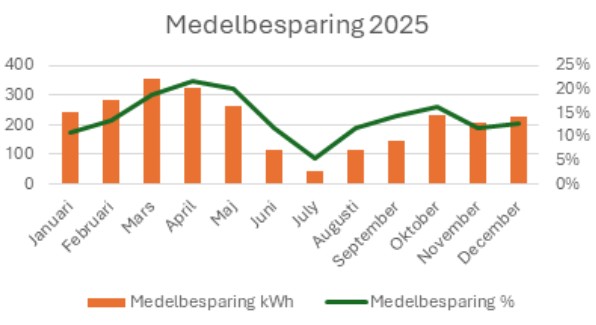
Graph 1. Shows average savings and percentage savings for just over 1,000 customers who use both district heating and electricity for heating. The greatest savings from eare achieved in mars, and the percentage savings are greatest during aApril.
The greatest savings come when the weather and the sun work together
In January 2025, households saved an average of 245 kWh, representing an 11 percent reduction in energy use. In April, the savings increased to an average of 323 kWh, accounting for a full 21 percent of the home’s total energy consumption—that is, heating and hot water.
The results clearly show how smart control systems can harness free energy from the sun while reducing the need for purchased energy.
Many people associate energy conservation with cold winter days and high energy/electricity prices. But data from Ngenic Energy shows that the greatest potential often lies in periods when the weather changes rapidly and the sun provides heat during the day.
The study covers households with both district heating and electric heating and shows that smart control is effective regardless of the type of heating.
Takes into account the sun, wind, and the building's behavior
Unlike traditional heating systems, Ngenic Tune doesn't just analyze indoor and outdoor temperatures. The system also uses weather forecasts and solar radiation to optimize heating in real time.
On a clear day, the sun can provide up to 1 kW of energy per square meter. Some of that heat is stored naturally within the building and can be used to reduce the need for active heating.
By understanding how each individual home responds to changes in the weather, Ngenic Tune can automatically adjust the heating and avoid unnecessary energy consumption.
Smart control is effective even during the summer
The study also shows that energy savings continue even during the summer months. Although the need for heating is significantly lower, cool nights and changeable weather can mean that many homes still use energy for heating, especially at night
Here, Ngenic Tune helps reduce unnecessary operation and optimize energy usage, even during periods of low consumption.
Lower energy consumption has a greater economic impact than many people realize
The savings vary depending on the heating system. District heating often provides the greatest energy savings in terms of kWh, while households with heat pumps—both older and newer models—can significantly reduce their heating costs through smart control systems.
The economic impact, however, is often comparable across different forms of heating. A common mistake is to base calculations solely on the price of electricity itself and not to include costs such as energy taxes, transmission fees, and other grid charges.
|
Fuel Consumption 2025
With Ngenic Tune |
Savings in 2025
With Ngenic Tune |
| Air-to-water heat pump |
8,191 kWh |
1,708 kWh |
4,252 SEK |
| District Heating |
14,934 kWh |
4,437 kWh |
4,714 SEK |
| Electric heating element |
9,255 kWh |
3,033 kWh |
6,940 SEK |
| Exhaust Air Heat Pump |
9,064 kWh |
2,136 kWh |
4,650 SEK |
| Ground-Source Heat Pump |
10,345 kWh |
2,002 kWh |
4,664 SEK |
| Total consumption without Ngenic Tune = Consumption in 2025 + Savings in 2025 |
Data-driven insights delivered directly to the user
To make the energy savings even clearer, Ngenic Energi has launched a new savings calculator feature. This feature allows users to quickly get an estimate of how much energy and money they will save over time.
At the same time, it retains the smooth and stable ride that has long been one of the most appreciated features of the Ngenic Tune.
A 1-Minute Summary of the Study
- The study covers just over 1,000 households in 2025
- Both district heating and electrically heated households are included in water-based heating systems
- The largest relative energy savings were recorded in April, at 21 percent
- The highest average energy savings were recorded in March and April
- Smart control systems use weather data, solar radiation, and the building's thermal behavior
- The savings affect both energy costs and grid fees for the electrically heated single-family home
Ultimately, the cheapest kilowatt-hour is still the one that never has to be used.