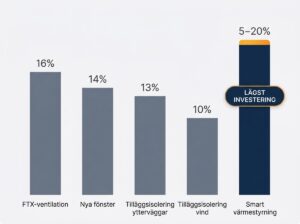
When we ask our customers what they appreciate most about Ngenic Tune, the answer is clear: comfort.
Reducing energy costs is, of course, important, but what really makes a difference in everyday life is a consistent and comfortable indoor climate—without having to think about it.
With over 15,000 users, we have developed a unique understanding of how Swedish homes are heated, what temperatures people actually prefer, and how smart control systems affect both comfort and energy use.
Swedes want it warm—but not in empty houses
Data from our users shows that the average desired indoor temperature in Swedish single-family homes is 20.8 degrees. At the same time, we can clearly see how many people use the “Schedule” feature to automatically lower the temperature when no one is home.
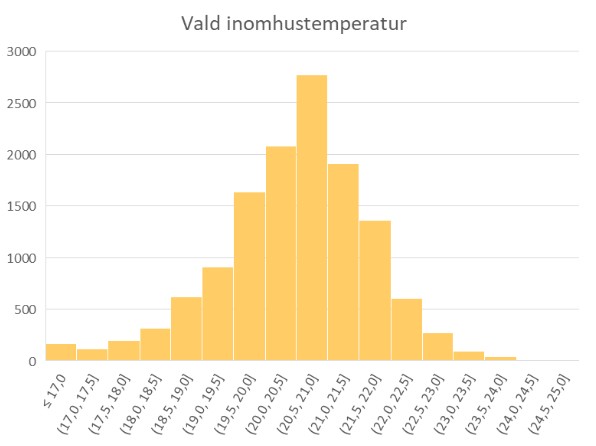
Graph 1: Shows the results of how 15,000 users set their desired indoor temperature in the app
It makes a big difference.
In a previous analysis, we found that households that used the “Away” schedule during winter break reduced their energy consumption for heating by an average of 41%. For many, that amounted to about 500 kronor in just one week—while still ensuring the house was warm and comfortable again when the family returned home. The “Planning” feature reduced energy consumption by 41% – Ngenic
A stable temperature isn't a feeling—it's measurable
Being able to set a temperature is one thing. Actually maintaining it is something else entirely.
When we analyze actual operating data from our users, we see that Ngenic Tune maintains the temperature within +0.3 degrees of the target temperature on average throughout the year. That is also why comfort consistently ranks as the most appreciated feature in our customer surveys.
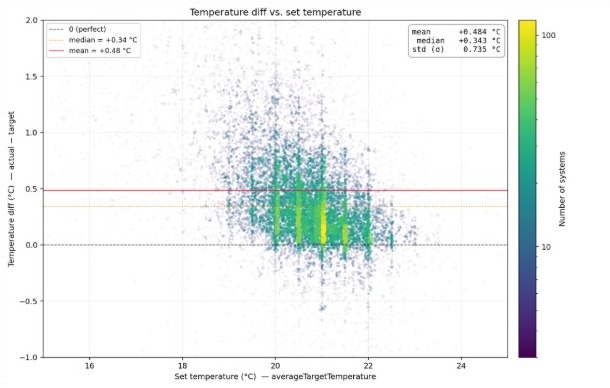
Graph 2: Shows the difference between the actual temperature and the desired temperature for 15,000 Ngenic Tune users. The median deviation is an impressively low +0.35 degrees over the course of the year.
The result is a home with more even heat, fewer temperature fluctuations, and a more comfortable indoor climate—all automatically.
Smart control saves energy regardless of the heating system
In connection with the launch of our savings calculator feature, we conducted a comprehensive analysis to understand how much energy and money households actually save with Ngenic Tune, depending on their heating system.
|
Fuel Consumption 2025
With Ngenic Tune |
Savings in 2025
With Ngenic Tune |
| Air-to-water heat pump |
8,191 kWh |
1,708 kWh |
4,252 SEK |
| District Heating |
14,934 kWh |
4,437 kWh |
4,714 SEK |
| Electric heating element |
9,255 kWh |
3,033 kWh |
6,940 SEK |
| Exhaust Air Heat Pump |
9,064 kWh |
2,136 kWh |
4,650 SEK |
| Ground-Source Heat Pump |
10,345 kWh |
2,002 kWh |
4,664 SEK |
| Total consumption without Ngenic Tune = Consumption in 2025 + Savings in 2025 |
The analysis shows that energy savings vary among different heating systems, with district heating often yielding the greatest energy savings in terms of kWh. However, households with heat pumps—both older and newer models—also significantly reduce their heating costs through the use of smart controls.
“A common mistake is to focus only on the price of electricity and overlook costs such as transmission fees, energy taxes, and other grid charges.”
Despite differences in energy savings, the financial impact is often similar. A common mistake is to base calculations solely on the price of electricity and overlook costs such as transmission fees, energy taxes, and other grid charges.
Ultimately, the cheapest kilowatt-hour is always the one that never has to be used.
Smart control is therefore not just about optimizing for spot prices, but also about using less energy overall—without compromising on comfort.